

Reading your vehicle report
Autoentic's vehicle report is called a Paint Passport. It holds a car's Autoentic inspections, saved to its vehicle identification number, or VIN. Autoentic measures the paint thickness on a car's body panels, compares each panel with factory data for that model, and saves the result to the car's VIN as a Paint Passport that anyone can look up free. This guide walks through one from the top, and says what it can't tell you.
How a Paint Passport differs from a history report or a gauge
A careful repaint can look just like factory paint, so looking at a car won't always tell you. A vehicle history report, such as Carfax or AutoCheck, lists what was reported about a car. A repair paid for out of pocket can leave no trace in it, so a clean history report doesn't mean the paint is original. A paint thickness gauge shows how thick the paint is. But factory paint differs by make, model and year. So without factory data for that model, a reading alone doesn't say whether a panel was repainted.
A Paint Passport compares each measured panel with factory data for that car's model. So it can show, panel by panel, where the paint reads differently from the factory's. The guide to checking a used car's paint before you buy explains when that helps most.
The score, grade and label at the top
To see a car's Paint Passport, type its VIN at autoentic.com/paint-passport. It's free, and you don't need an account. Anyone who types the VIN sees the same page, and it stays with the car when the car is sold. A link someone sends you can be out of date, so typing the VIN yourself is the surest way to see the current page. Looking up a car by VIN explains each result the lookup can give.
The top of the Paint Passport names the car by its year, make and model, and shows its VIN. Check that it matches the VIN on the car, which you'll find through the windshield on the driver's side.
Below that, a summary box shows the result at a glance. The large number is the score. FOCS, the Factory Originality Confidence Score, is a number from 0 to 100 for how confident the measurement is that the paint is factory-applied. A higher score means more confidence. It is not a percentage of original paint.
Beside the score is the overall grade. It reads Factory Original at the top, Factory Acceptable in the middle or Refinished at the bottom. Each panel gets a label in the same words, explained with the panel list below. Under the grade sits Autoentic's label for the inspection. Autoentic Inspected means the car was measured and the result is on record. Autoentic Certified is the top label. What Autoentic certification means explains when a car carries it, and what each grade means.
One more line sums up the panels, such as "2 panels refinished: Front left door, Left fender." When every panel reads Factory Original, the line says that instead.
Notes beside the score
These notes appear only when they apply, in the summary box or beside an inspection.
A short line right under the grade tells you something the grade alone doesn't. For example, it can say that some panels carry an added layer, and that the paint under them is unverified. Treat those panels as unverified, not as original.
A note marked Factory reference means the factory data on file isn't an exact match for your car's version, and the note says how. Read the result with that in mind. It doesn't mean the measurement is wrong.
The Provenance line is about how the readings were taken. It isn't about the paint, or about the car's past owners. It reads High, Moderate or Low, or says it wasn't assessed.
A Record status box appears only when there's something to say about the car's records as a whole. For example, two inspections may disagree, or a record may be disputed or could not be verified.
A dash in place of a score means Autoentic measured the car but couldn't give it a score. The summary says why, such as "No factory specification match for this vehicle" when there's no factory data on file to compare the car with. Its panels then read Not Scored (No Factory Specification). An inspection without a score says nothing about whether the paint is factory.
The inspection history
Under Inspection history, the car's inspections are listed newest first. Each one shows its date, score, grade and label. A line above an inspection can say why it was made, such as "Buyer's check". It also names who made it: "by Autoentic", or the name of a business Autoentic has confirmed. An inspection by a business Autoentic hasn't confirmed names no one. When no reason was given, the line reads Reason not recorded.
Most inspections also have a line that compares them with the one before. "Changed since" names each panel whose label changed, and "No change since" means none did. The earliest inspection reads "Baseline". These lines compare only the inspections shown on the page, so they say "published records only".
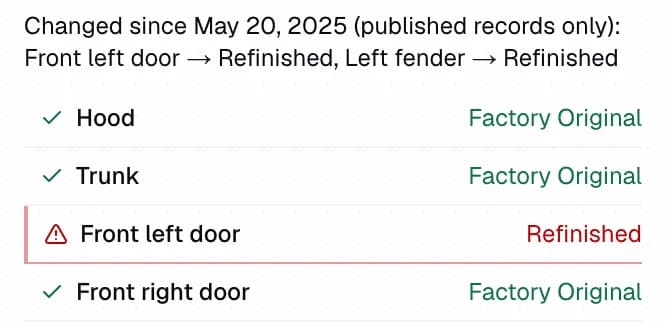
View all panels opens an inspection's panel list. Each panel shows its name and its label, with no numbers. Factory Original means the readings are consistent with paint applied at the factory. Factory Acceptable means they lean away from factory paint, but not far enough to call the panel refinished, so look at that panel more closely. Refinished means they differ clearly from factory paint, consistent with a touch-up or repaint. A panel can also read Added Layer (Undetermined Type), which the page on Added Layer results explains.
Each inspection shows the paint as it was on the day it was measured. When more inspections are on file than the page shows, a line above the history says how many. So the list you see may not be all of them.
What a Paint Passport can't tell you
The report ends with a box called What this proves and what it doesn't. Autoentic measures paint, not damage. A record says what was measured. It never says why a panel was refinished, and it is not a guarantee. So if a panel reads Refinished, a buyer will want to know what was done to it. If you're buying, ask the seller, and ask to see any paperwork. If it's your car, keep the paperwork for any work done. Each record is sealed when it is submitted. A later change to a sealed record would show.
Each inspection covers only the panels it measured, and so does its grade. An inspection of the metal body panels leaves out the plastic ones, most often the bumpers. A newer inspection can cover fewer panels than an earlier one, so read the earlier ones too.
What if I think a result is wrong?
A label changes only with a new measurement. Book a new inspection, and it's added to the Paint Passport. The earlier one stays as it was measured. If something on the record isn't about the paint, such as the wrong VIN, write to support@autoentic.com.
To have a car's paint measured, book an inspection.