

Selling your vehicle
When you sell a used car, buyers wonder whether its paint is original, and a seller's word isn't proof. So before you list it, have the paint measured, with the result linked to the car's vehicle identification number, or VIN. Autoentic measures the paint thickness on a car's body panels, compares each panel with factory data for that model, and saves the result to the car's VIN as a Paint Passport that anyone can look up free. A buyer can then type the VIN at autoentic.com/paint-passport and see what the measurement found, instead of taking your word for it.
Why buyers ask about a used car's paint
A repainted panel raises questions a buyer wants answered before paying, such as what happened to it and how well it was fixed. A careful repaint can look just like factory paint, so a buyer can't tell by looking. If you bought the car used, you may not know its paint history yourself. Some buyers have the car checked by an inspector of their own before they pay. If their inspector finds a refinished panel, it comes up late, in the middle of the deal.
Why your word and a clean history report aren't enough
A buyer has no easy way to check your word. A clean vehicle history report, such as Carfax or AutoCheck, doesn't show whether the paint is original either. It lists what was reported about a car, and a repair paid for out of pocket, or a cosmetic touch-up, can leave no trace in it. Check a used car's paint before you buy explains it from the buyer's side.
Why a buyer's own gauge reading can mislead
A buyer or their inspector may bring a paint thickness gauge, sometimes called a paint meter. It shows how thick the paint is where its probe touches, but a number is not an answer. Factory paint thickness differs by make, model and year, so a reading taken without factory data for that model can make original paint look repainted. Paint protection film, a clear film some owners put over the paint, adds to a reading too.
What an Autoentic inspection gives you
Like a buyer's gauge, an Autoentic inspection starts with a probe on the car's body panels. The difference is that Autoentic compares the readings with factory data for that model. Each panel then gets a label on the car's Paint Passport, such as Factory Original or Refinished. What Autoentic certification means explains each label.
The result is saved to your car's VIN. Each record is sealed when it is submitted. A later change to a sealed record would show. Each inspection shows the paint as it was on the day it was measured, not anything done after. The Paint Passport stays with the car, not with you, so the next owner can look it up too.
No one's word changes a panel's label. A label changes only with a new measurement. A new inspection is added to the Paint Passport beside the earlier ones, and buyers see each of them with its date.
If a panel reads Refinished
Say you're selling a five-year-old sedan, and you had it measured before you listed it. A buyer looks up its VIN the night before the test drive. Every panel measured reads Factory Original except the front left door, which reads Refinished.
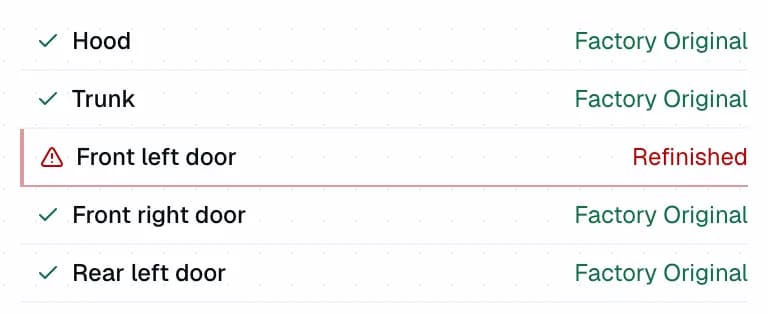
The buyer will want to know what happened. Tell them about the repair and bring the receipt. If you don't know the door's history, say so. Either way, the buyer hears about the door from you and the Paint Passport, not from their own inspector later.
What a Paint Passport can't tell a buyer
A record says what was measured. It never says why a panel was refinished, and it is not a guarantee.
A panel that reads thicker than factory paint but can't be identified reads Added Layer (Undetermined Type). The Paint Passport then says the paint underneath is unverified. A buyer will read that panel as unverified, not as original, since the paint under it may be factory paint or a repair. Only a measurement taken before anything was added can verify the paint underneath.
An Autoentic inspection checks the paint only, not how the car runs, so it doesn't replace a mechanical inspection. Autoentic doesn't say what a repainted panel does to a car's price. The Paint Passport gives you and the buyer the same facts about the paint.
Having your car measured, and what it costs
You book online, choose an Autoentic partner shop near you and bring the car in. If no shop near you can take the car, the booking page tells you before you pay. A technician measures the paint in about 10 minutes, and nothing scratches or marks it. The result then goes on the car's Paint Passport. Booking an inspection covers each step, including changing or cancelling a visit.
An Autoentic inspection is priced per car, not per panel. Metal Panels costs $49 a car and measures the metal body panels. All Panels costs $99 a car and measures metal and plastic panels. Metal Panels leaves out the plastic panels, most often the bumpers, and a buyer can see which panels were measured. If you want buyers to see every panel, choose All Panels.
Sharing your Paint Passport with buyers
Put the VIN in your listing so buyers can look up the car's Autoentic Paint Passport. Anyone can look it up free by typing the VIN at autoentic.com/paint-passport, with no account and without owning the car. On the car's Paint Passport page, the Share button copies its link, and on a phone it opens your share options. The Print button opens your browser's print window, where you can also save it as a PDF to bring to a viewing. A buyer who wants to check a printout or a shared link can type the VIN at autoentic.com/paint-passport, since the page online is always the current one.
If a buyer's gauge and your Paint Passport disagree about a panel, look at the inspection's date together. Then check whether that panel was measured. If you trade the car in, a dealer's appraiser may check the paint with a gauge of their own. They can look up the Paint Passport too. Reading your vehicle report walks through every line a buyer will see on the Paint Passport.
To have your car measured, book an inspection.