

How Autoentic works
Autoentic is a paint inspection service for cars. Autoentic measures the paint thickness on a car's body panels, compares each panel with factory data for that model, and saves the result to the car's VIN as a Paint Passport that anyone can look up free. The VIN, or vehicle identification number, is the 17-character code that identifies one car. Measuring a car takes about 10 minutes. Its Paint Passport, at autoentic.com, then shows panel by panel how the paint compares with the factory's.
Why a car's paint is hard to check
When a car changes hands, the buyer often wants to know whether its paint is original. A seller whose car still has its original paint wants to be able to show it. But a careful repaint can look just like factory paint, so looking at the car won't always tell you.
A vehicle history report, such as Carfax or AutoCheck, lists what was reported about a car. A repair paid for out of pocket can leave no trace in it. So a clean report means nothing was reported, not that the paint is original.
A paint thickness gauge, sometimes called a paint meter, shows how thick the paint is where its probe touches a panel. But factory paint thickness differs by make, model and year, so there's no single normal number to hold a reading against. A number alone doesn't say whether a panel was repainted. The guide to checking a used car's paint before you buy goes through each of these checks.
What Autoentic adds: factory data for the car's model
An Autoentic inspection starts the way a gauge does, with a probe on the car's body panels. The difference is what the readings are compared with. Autoentic compares each panel with factory data for that car's model, and a gauge on its own has no such data. So instead of a thickness reading you'd have to interpret, each panel gets a label that says how its paint compares with the factory's.
Autoentic keeps factory data on file for the models it covers. When there's none on file for a car's model, the car is still measured and the result is recorded, but it gets no score. Its panels then read Not Scored (No Factory Specification), which says nothing either way about the paint.
How an Autoentic inspection works
- Measure. The paint on each body panel the inspection covers is measured with a professional paint thickness probe connected to the Autoentic app. Nothing scratches or marks the paint.
- Compare. The readings are compared with that model's factory data, and each panel gets a label.
- Save. The result is saved to the car's VIN as a new, dated entry on its Paint Passport, where anyone can look it up.
Technicians at Autoentic partner shops do the measuring. A partner shop is a local business that works with Autoentic. Businesses can also measure their own cars. A dealership, for example, can measure its new cars before delivery.
What the panel labels, grade and score mean
Each measured panel gets a label. Factory Original means the readings are consistent with paint applied at the factory. Factory Acceptable means they lean away from factory paint, but not far enough to call the panel refinished. It's the panel to look at more closely. Refinished means they differ clearly from factory paint, consistent with a touch-up or repaint.
Added Layer (Undetermined Type) means the panel reads thicker than factory paint, and the measurement can't tell what the extra layer is, so Autoentic doesn't guess. Treat the paint under it as unverified, not as original.
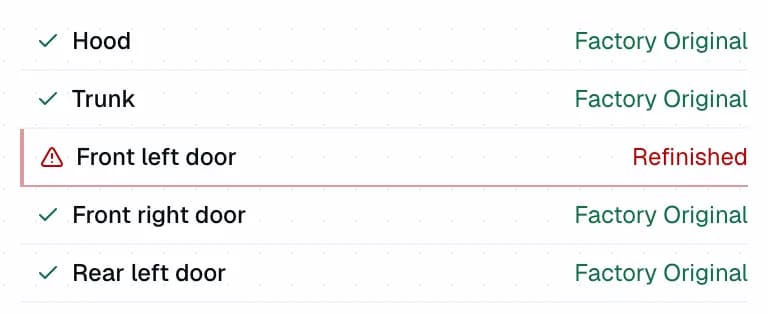
The car as a whole also gets a grade, in the same words. Factory Original is the top grade, Factory Acceptable is the middle one and Refinished is the lowest. Beside the grade is Autoentic's score. FOCS, the Factory Originality Confidence Score, is a number from 0 to 100 for how confident the measurement is that the paint is factory-applied. A higher score means more confidence. There is one per inspection, and it is not a percentage of original paint. The scoring method is patent pending.
Autoentic Inspected and Autoentic Certified
Each graded inspection also carries one of two labels for the inspection as a whole. Autoentic Inspected means the car was measured and the result is on record. It isn't a pass or a fail, and a car with a refinished panel is still Autoentic Inspected. Autoentic Certified is the top label. A record can carry it when the measurement shows factory paint with high confidence and the record was made by Autoentic, by a business Autoentic has confirmed as independent, or by a dealer's new-car department on a car never listed for sale as used. A Certified record needs both, so a car can read Factory Original on every panel and still be Autoentic Inspected. What Autoentic certification means explains both labels.
Can I trust a Paint Passport?
An Autoentic Paint Passport records a measurement, not a report of events. The paint is measured panel by panel with a professional probe, and the score is GUM-based. The GUM is the international guide to measurement uncertainty, and the score allows for the normal variation in any paint measurement.
Each record is sealed when it is submitted. A later change to a sealed record would show. A new inspection adds a new dated entry and never replaces an earlier one.
A record says what was measured. It never says why a panel was refinished, and it is not a guarantee. Autoentic measures paint, not damage. Each inspection lists the panels it measured and speaks only for those, on the day they were measured. One that covers only the metal panels leaves out the plastic ones, most often the bumpers.
Looking up a car's Paint Passport
To see a car's Paint Passport, type its VIN at autoentic.com/paint-passport. It's free, you don't need an account, and everyone who looks up the same VIN sees the same page. The Paint Passport is saved to the car's VIN, not to an owner, so it stays with the car when it's sold. If the lookup finds no inspections, that says nothing about the paint, either way. The guide on how to read a Paint Passport walks through one part by part.
Having a car measured, and what it costs
You book an inspection online, and a technician measures the car at an Autoentic partner shop near you. If no shop near you can take the car, the booking page tells you before you pay. If you're selling, buyers see the same Paint Passport you do. If you're buying, you can ask to have the car measured before you sign, with the seller's agreement.
An Autoentic inspection is priced per car, not per panel. Metal Panels costs $49 a car and measures the metal body panels. All Panels costs $99 a car and measures metal and plastic panels. Plastic panels, most often the bumpers, need a different probe.
Businesses that measure their own cars, such as dealerships, use the Autoentic app with a supported probe. For other businesses shows where each kind of business starts.
To have a car measured, see Pricing.